HOW TO PLAY LUDO (Vietnamese Horse Chess)
Introduction
Ludo (Horse Chess) is a popular Vietnamese board game for 2 or more players. Each player controls a team of 4 horse pieces of the same color. The goal is to move all your horses around the board and into the stable (home) before your opponents.
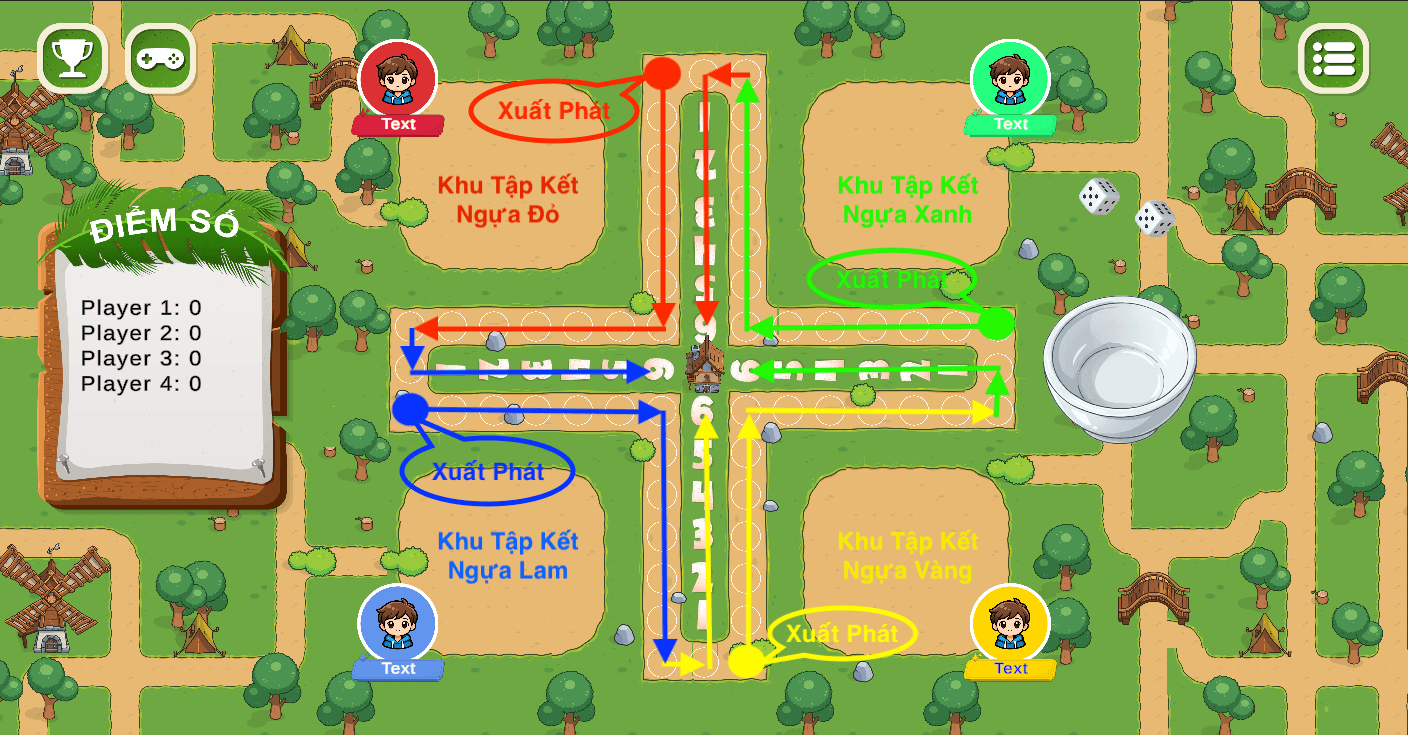
Objective:
- Move all 4 of your horses from the starting area → complete one full lap around the board → enter the stable → reach the final destination slots.
- The first player to get all 4 horses to the finish wins (or players are ranked by order of completion).
Basic Rules
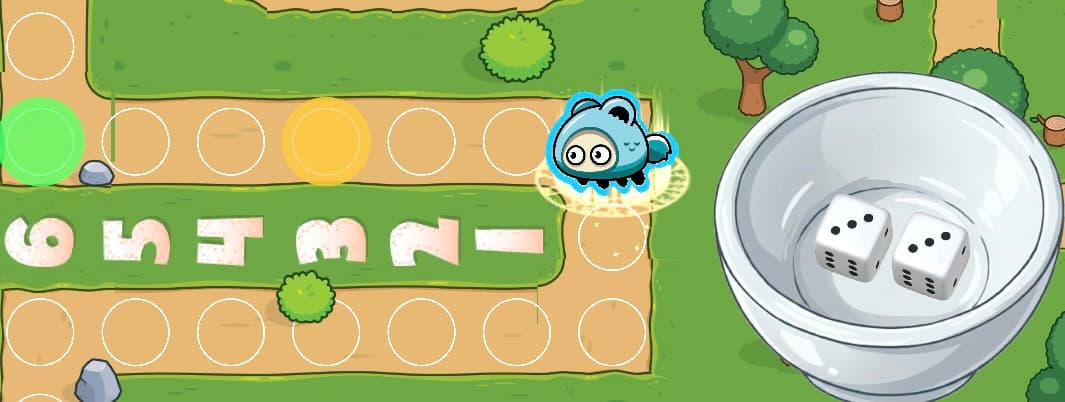
- Players take turns rolling two dice.
- The total on both dice determines how many spaces a horse moves.
- If you roll a pair (doubles), you may choose to move by the value on one die or by the sum of both dice.
Example:
You roll 3–3 (a pair)
→ You may choose to move 3 or 6 spaces.
- If you roll 1–6, you can only move 7 (the sum).
- Rolling a pair grants you an extra turn.
- Valid pairs: 1–1, 2–2, 3–3, 4–4, 5–5, 6–6, or 1–6.
- Horses travel counter-clockwise along a fixed path around the board, then turn into their own colored stable.
DEPLOYING HORSES
- At the start, all horses are in the base (staging area).
- To bring a horse onto the board, you must roll: a pair (1–1, 2–2, 3–3, 4–4, 5–5, 6–6) or 1–6.
- When deployed, the horse is placed on the starting tile of your color.
Mandatory deployment rule:
If your starting tile is empty and you still have horses in the base, rolling a pair forces you to deploy a new horse (unless the “forced kick” feature is enabled, in which case that turn is used to kick an opponent instead).
KICKING OPPONENTS
If your horse lands on a tile occupied by an opponent’s horse, you kick that horse back to its base. The kicked horse must be re-deployed from scratch.
Forced kick rule
- If any of your moves can kick an opponent’s horse, you must take that move — you cannot choose a different move instead.
- You may not skip a kicking opportunity to move another horse or go to a different tile.
Example:
You roll 1–5 (total 6) and one of your horses is exactly 6 spaces behind an opponent → you must move that horse to kick.
Chain kick (Đá liên)
In a single dice roll, if your horse’s path passes through or ends on multiple tiles occupied by opponents, all of those opponents’ horses are kicked. This applies when using the total of both dice or when rolling a pair.
Example 1 (chain kick via sum):
You roll 3 and 4 (total 7)
On the 7-space path there are 2 opponent horses at space 7 and space 14 → both are kicked.
Example 2 (chain kick via pair):
Dice show 3 and 3
Move 3 or 6 spaces to kick 1 horse
Move another 3 or 6 spaces to kick 1 more horse → chain kick.
When the multi-horse chain kick feature is enabled, a single dice roll can control multiple horses to kick simultaneously.

Combo kick (Đá liên hoàn)
- After kicking any horse, the player gets an immediate extra dice roll.
- If that extra roll also results in a kick, the player rolls again.
- There is no limit on extra rolls as long as you keep kicking.
Example:
Roll 5 → kick 1 horse → roll again
Roll 6 → kick 1 more horse → roll again
Roll 3 → no kick → turn ends
Blocking rule (Buộc đì)
A special situation where an opponent’s horse is sitting on or near another player’s starting tile (within 2 spaces), and your horse is ahead of it by no more than 3 spaces. Your horse is considered to be “blocking” the opponent at their start gate.
The purpose is to create a dangerous situation for the opponent and prevent them from deploying freely.
When this situation occurs:
You are not allowed to move the blocking horse — you must move a different horse if possible.
Both conditions must be met:
- Opponent’s horse is on (or within 2 spaces of) another player’s starting tile.
- Your horse is ahead by 1, 2, or 3 spaces (not exceeding 3).
Exception (force majeure):
If you only have 1 horse on the board, you may move it regardless of the blocking position.
REACHING THE FINISH
After a horse completes a full lap, it enters the stable and must continue moving through destination slots in order to finish.
The destination zone has slots numbered: 1 → 2 → 3 → 4 → 5 → 6.
A horse is considered finished when:
- It has reached the final (highest) destination slot
- It no longer needs to move
- Once all 4 horses are at positions 6 → 5 → 4 → 3, you win.
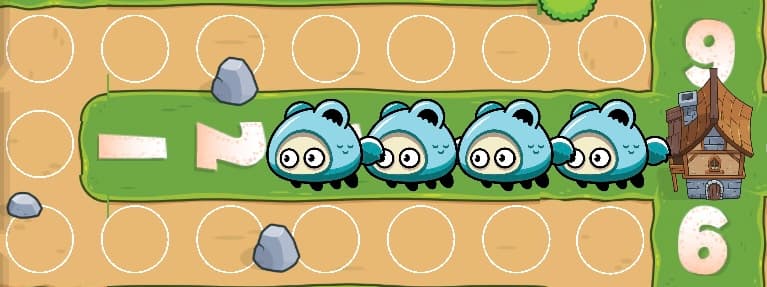
Two ways to finish:
Case 1: Horse enters the finish directly — no special condition needed.
The horse is still on the outer track. If the dice total allows it to cover the remaining outer spaces and continue exactly into the destination zone.
Example:
Horse is 3 spaces from the stable entrance
You roll 9 → move 3 spaces to the entrance, then 6 more into slot #6.
→ The first horse in a match to land directly on slot #6 earns Thầu Mạ (jackpot).
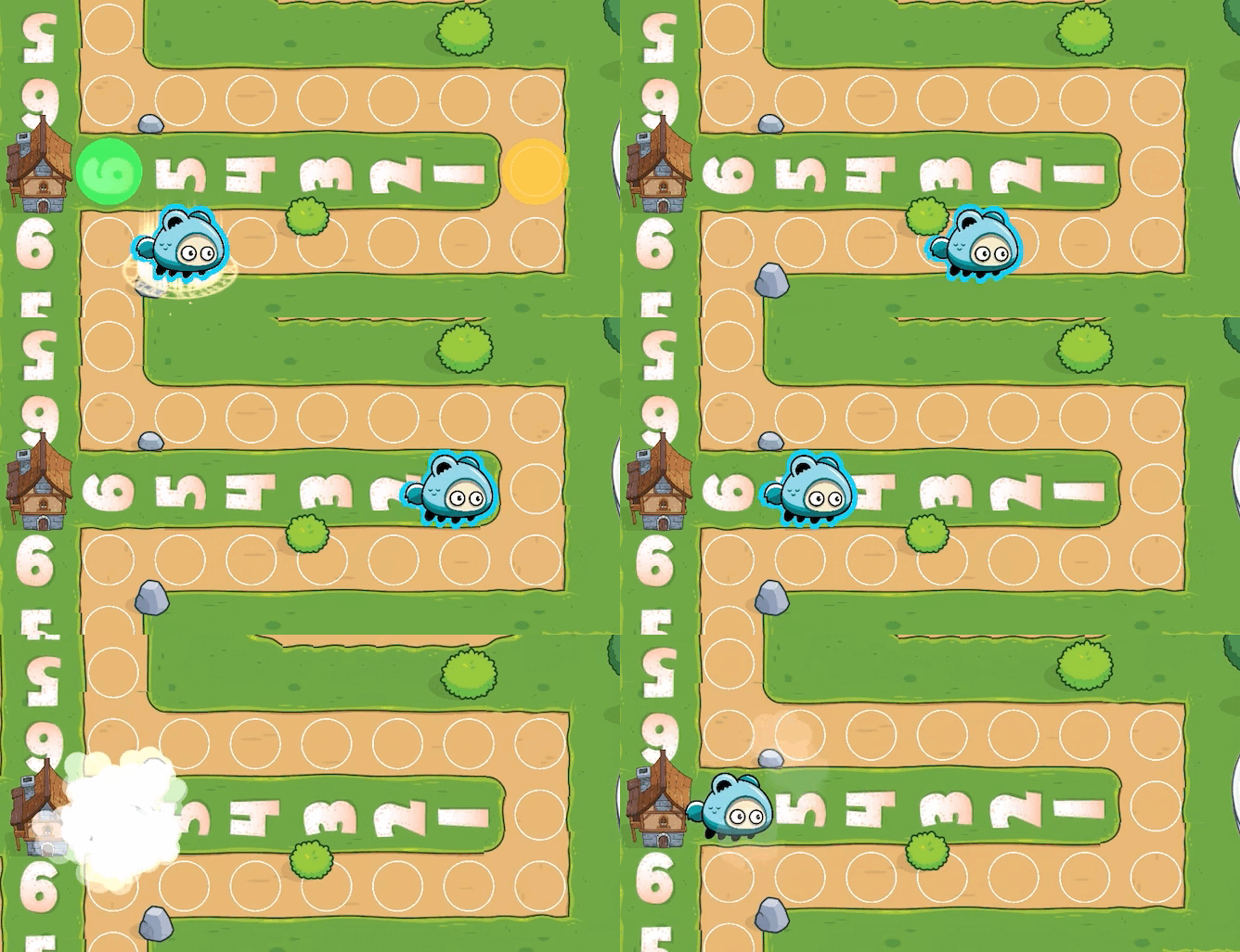
Case 2: Horse enters stable but hasn’t reached the finish — special condition required.
Example:
Horse is 3 spaces from the entrance
You roll 5 → move 3 to enter, then 2 more into slot #2
→ To advance to slot #3, you need to roll a pair or a total of 3.
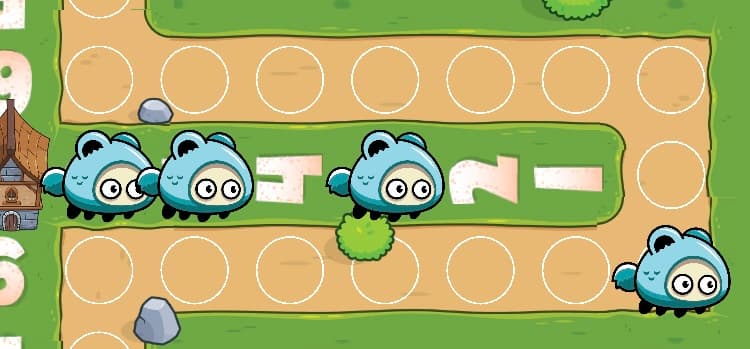
Once inside the stable, horses cannot move freely — they must advance in order: 1 → 2 → 3 → 4 → 5 → 6.
To move a horse inside the stable, you must roll a pair or a total matching the number of the next target slot.
Example:
Horse is on slot #3 → to move to #4 → roll any pair (except 1–6), or roll a total of 4.
Horse is on slot #4 → to move to #5 → roll any pair (except 1–6), or roll a total of 5.
Valid rolls:
Roll 1–4 (total = 5) → allowed to advance to slot #5
Roll 2–3 (total = 5) → allowed to advance to slot #5
Special case: landing on slot #1 incurs a penalty
If a horse enters the stable and stops exactly on destination slot #1, the player must pay penalty points to every other player. This is a punishment for finishing at the lowest position.
Example: 4 players → you land on slot #1 → you pay points to the other 3 players.
Horses that are in the stable but haven’t reached the final slot, or are still on the outer track, count as “not finished.” If none of your horses have finished, you are considered Cón (shut out).
Scoring Rules
STANDARD KICK
- Each horse kicked earns 1 point.
- If kicked using a pair, it counts as an “old horse” (2 points).
CHAIN KICK SCORING
COMBO KICK SCORING
Total combo score = (Kick points) × (Number of kicks)
- Kick points: calculated per standard or pair kick rules.
- Number of kicks: how many separate turns resulted in a kick.
Example: 4 combo kicks
Turn 1: Roll 2–3 → kick 2 horses → 2 pts/horse (subtotal: 4 pts)
Turn 2: Roll 1–5 → kick 1 horse → 2 pts/horse (subtotal: 2 pts)
Turn 3: Roll 5–5 → kick 2 horses → 12 pts/horse (subtotal: 24 pts)
Turn 4: Roll 1–3 → kick 2 horses → 8 pts/horse (subtotal: 16 pts)
CAVE-IN (Sụp Hầm)
- Landing on slot #1 when entering the stable costs 1 point per opponent.
- If entering via a pair roll, it costs 2 points per opponent.
JACKPOT (Thầu Mạ)
- The first horse in a match to enter the stable directly into slot #6 earns Thầu Mạ.
- Standard Thầu Mạ: receive 4 points from each opponent.
- Pair Thầu Mạ: receive 6 points from each opponent.
FINISH POINTS (Về Đích)
- A horse reaching the final slot is considered “Finished.”
- Direct finish with standard roll: 2 points from each opponent.
- Direct finish with pair roll: 3 points from each opponent.
- Finish by climbing through slots: 1 point from each opponent.
WINNING THE MATCH
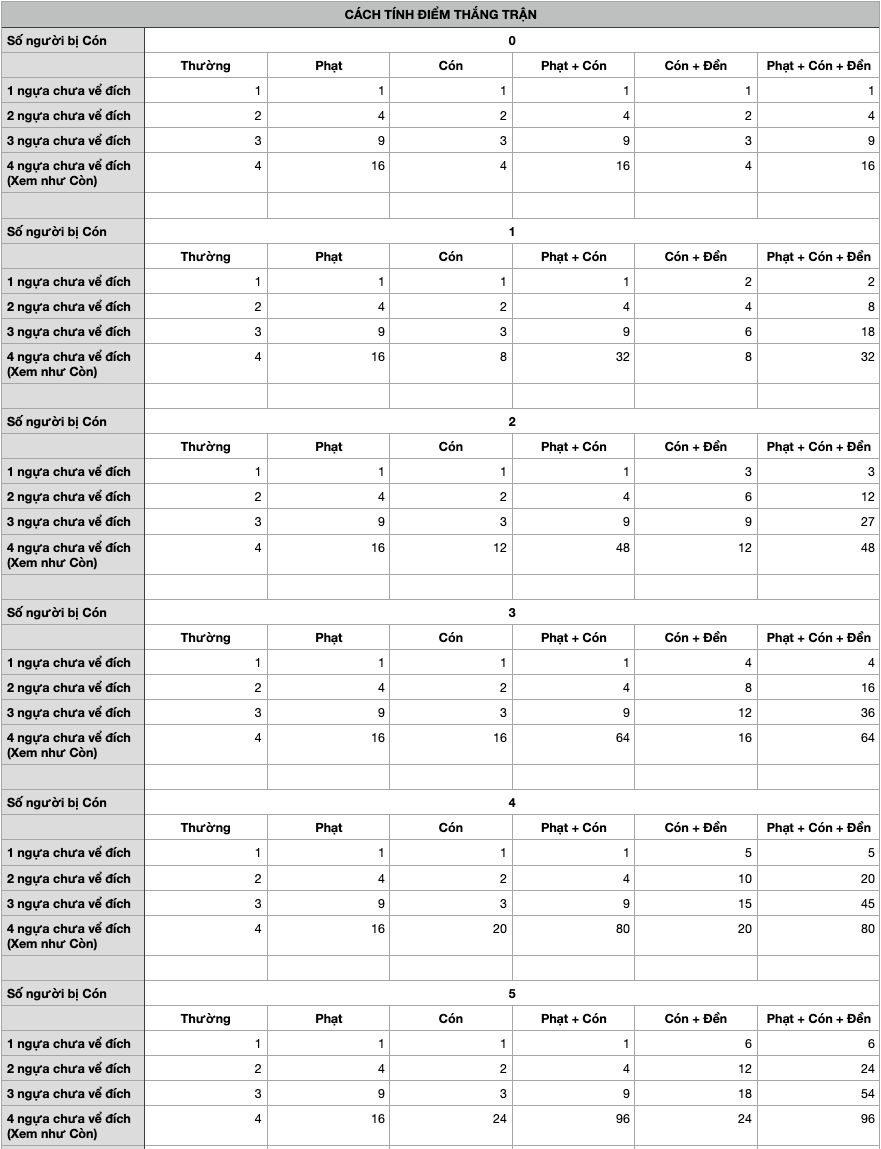
Winning points are calculated from 3 main factors:
- Number of unfinished horses the losers have
- Number of players who are Cón (shut out)
- Types of points: Standard, Penalty, Cón, Compensation
Standard Points
Each unfinished horse = 1 point.
Penalty Points
Penalty increases with the number of unfinished horses.
Formula: Penalty = (unfinished horses) × (unfinished horses)
Cón Points (Shut-out)
A player is Cón if all 4 horses are unfinished.
If anyone is Cón, losing points are multiplied.
Formula: Cón points = Standard points × (Number of Cón players + 1)
Compensation Points (Điểm Đền)
Applies when the Cón feature is enabled, for players who haven’t fully finished but are not Cón. Also multiplied by the number of Cón players.
Formula: Compensation = Standard points × (Number of Cón players + 1)